
Slip-On Welded Collar
A metal ring slides over a compatible pipe and uses a drawing-defined weld to secure and seal the interface.
A loose puddle flange is supplied separately so it can slide over, clamp around or otherwise attach to a compatible pipe before concrete placement. Therefore, buyers must specify the pipe OD, flange bore, material and approved attachment method.
This water-stop component arrives as a separate plate, ring or collar rather than as part of a finished pipe spool. Installers or fabricators position it on the specified pipe and secure it by the approved method. Afterwards, the assembly becomes embedded within the concrete wall or slab.
The radial projection interrupts the direct path along the pipe-to-concrete interface. However, its performance also depends on attachment continuity, correct positioning and well-consolidated concrete. The flange does not replace required structural joints, movement details or other waterproofing measures.
A separate collar offers flexibility when the project sources pipe and water-stop components independently. By contrast, a factory-fabricated puddle pipe arrives with the plate already attached and inspected as one assembly.
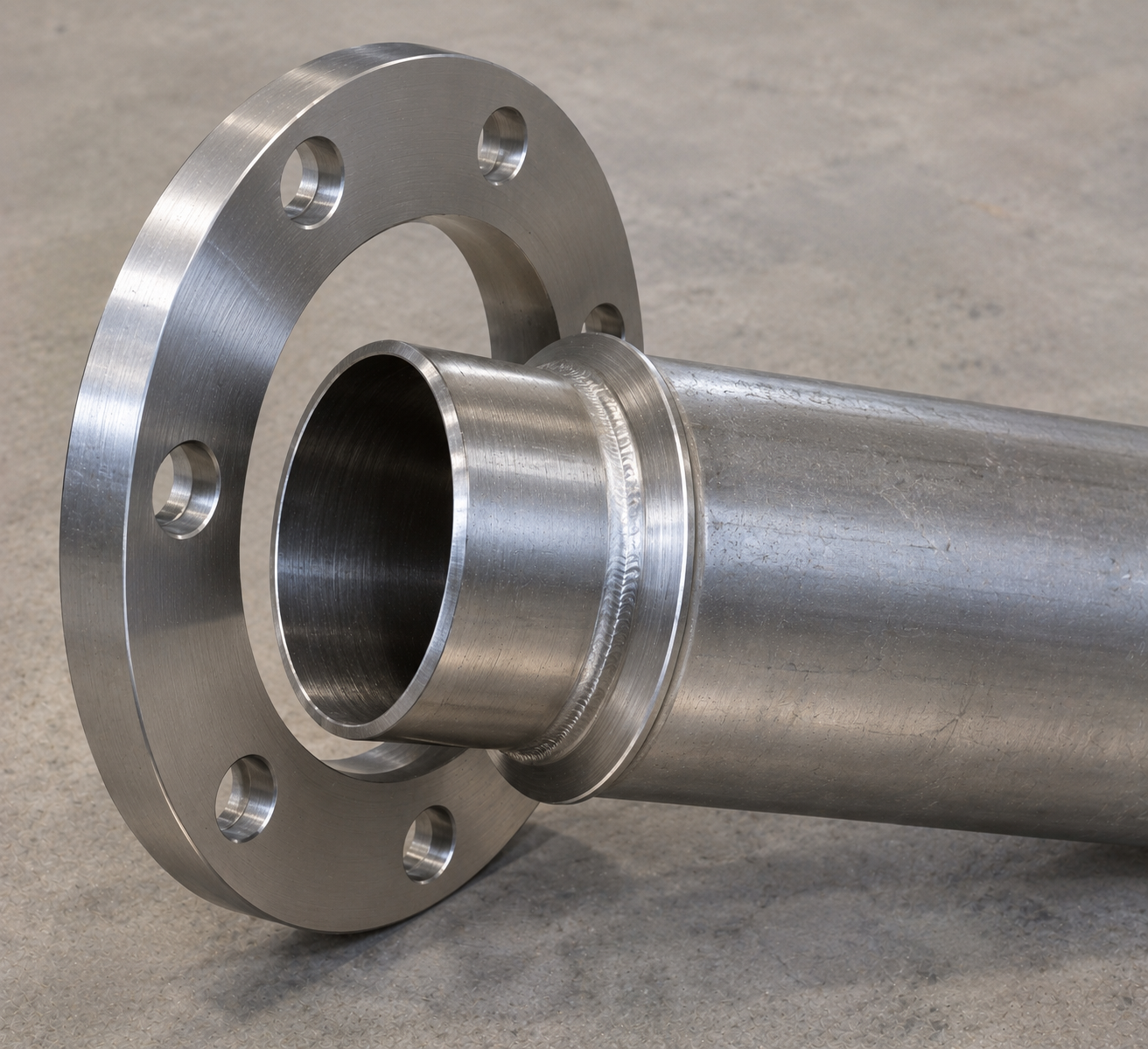
The phrase can describe several products with different attachment principles. Consequently, the enquiry should identify the intended design.
A metal ring slides over a compatible pipe and uses a drawing-defined weld to secure and seal the interface.
Two or more segments assemble around an existing pipe where a one-piece ring cannot pass over the end.
A mechanical design uses specified seals and fasteners rather than direct welding to the pipe.
A compatible plastic component follows its manufacturer-approved fusion, bonding or mechanical method.
Product distinction: “loose” describes separate supply; it does not prove adjustability, split construction or a particular sealing method. State the exact type on the drawing.
A complete description defines the collar, pipe and attachment as one interface. Accordingly, include these requirements.
| Pipe details | Material, standard, nominal size, actual OD, wall thickness and dimensional tolerance. |
|---|---|
| Flange bore | Finished inside diameter, required clearance or interference, and manufacturing tolerance. |
| Plate dimensions | Outside diameter or width, radial projection, thickness, opening and shape. |
| Collar construction | One-piece, split, segmented, sleeve type or another drawing-defined arrangement. |
| Attachment | Welded, clamped, fused, bonded or proprietary method with applicable procedure. |
| Material | Specified grade and product form, including compatibility with the carrier pipe. |
| Surface finish | Coating, galvanizing, passivation, cleaning or other specified final treatment. |
| Inspection | Dimensions, material records, weld or clamp checks, NDT and documentation requirements. |
Standards note: cite the exact pipe, material, welding and coating standards in the purchase order. The official ISO standards catalogue can help teams confirm current published documents.
Correct bore selection supports installation and the designed attachment. Therefore, verify the physical pipe rather than selecting the ring from nominal size alone.
Pipe series and material can produce different ODs for the same nominal designation.
A slip-on ring needs enough clearance for assembly without creating an unacceptable attachment gap.
Measure or specify allowable variation, especially for large fabricated or plastic pipe.
Clarify whether the stated pipe OD is bare, coated or lined and when coating will be applied.
The component and pipe materials must suit the joining method and service environment. In addition, dissimilar materials may need isolation or a mechanical interface.
These fabricated options can suit compatible steel pipe with a specified coating or lining system.
Zinc-coated components require a defined base grade, galvanizing standard and repair procedure.
The exact stainless grade, finish and contamination controls should match the approved service conditions.
Use only a collar designed for the exact pipe material, OD, temperature and attachment method.
The sequence depends on the flange type. Nevertheless, a typical pre-pour workflow includes the following controls.
First, confirm material, actual OD, flange bore, plate dimensions and item identification.
Next, transfer the approved plate location onto the pipe and check wall projections.
Slide, assemble or clamp the component without damaging the pipe or protective surfaces.
Then, weld, tighten, fuse or seal the interface under the released procedure.
Brace the assembly independently at the required line, level and wall location.
Finally, record the attachment, dimensions, clearance, cleanliness and support before casting.
For broader pre-pour and concrete-placement guidance, see the puddle flange installation guide. The product-specific drawing and site method statement remain controlling.
Inspection should confirm both the supplied collar and its completed pipe interface.
Check markings, grade, certificates and traceability when the purchase order requires them.
Measure the bore, plate OD or width, thickness, opening and fitted plate position.
Review welds, clamps, seals or fusion joints against the approved procedure and acceptance criteria.
Confirm cleanliness, coating or finish, permitted repairs and protection before concrete placement.
Separately supplied collars suit projects that procure or install the pipe independently. For example, applications may include:
Application limit: confirm that the selected design suits the pipe material, pressure, temperature, chemical exposure, movement and construction sequence.
For an accurate compatibility review and quotation, send:
It is a separate ring, plate or collar supplied for fitting around a compatible pipe before concrete placement. The design may use welding, clamping or another approved attachment.
Not always. “Loose” means the component arrives separately, while “adjustable” describes a design that allows positional or diameter-related adjustment. Some products may have both features.
No. Actual pipe OD varies by material and standard. The flange bore, clearance and attachment must match the exact pipe dimensions.
No. Some metal collars use welding, while split, clamped or proprietary systems use different methods. Follow the approved product design and installation procedure.
A purpose-designed split collar may assemble around an existing pipe. However, the joint, seals, fasteners, clearance and concrete detail require engineering approval.
The approved penetration drawing defines its centreline or offset, reinforcement clearance, concrete cover and pipe projections.
Send the actual pipe OD and material, collar type, bore, plate dimensions, attachment method, material grade, quantity and inspection scope.
Send Mesta Inc. your pipe dimensions, flange geometry and attachment requirements. Then, our team can review fit, material, fabrication and inspection scope.