
Vertical Floor Drain Puddle Flange
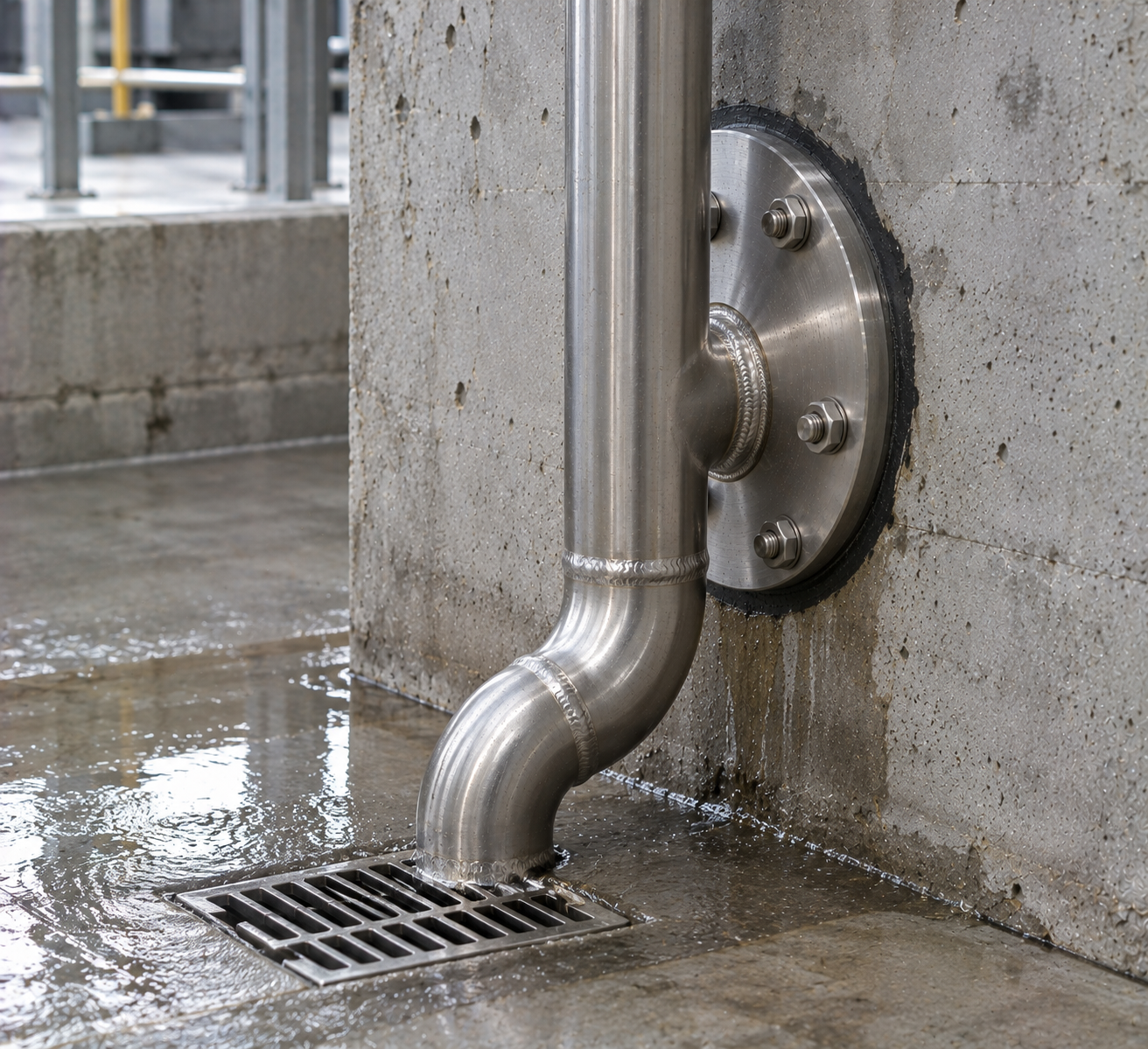
A vertical drain pipe passes through a slab or tank base. The drawing sets the top level, plate depth and lower pipe projection.
Mesta Inc. manufactures Puddle Flange Drain assemblies for pipes passing through concrete walls, slabs, tanks and pits. Moreover, we coordinate the drain size, water-stop plate, pipe material, outlet direction, connection ends and embedment position with the approved drawing.
A Puddle Flange Drain is a drainage pipe or sleeve with a projecting water-stop plate around its outside surface. The plate remains embedded in concrete and interrupts the direct path through which water could track beside the pipe. Therefore, the assembly helps manage leakage risk at drain penetrations through water-exposed structures.
The product does not replace the drain body, trap, grate, membrane or pipe-joint seal. Instead, it addresses the interface between the drain pipe and surrounding concrete. Designers should coordinate all these components to create a complete drainage and waterproofing detail.
Mesta Inc. manufactures each pipe puddle flange from project data. Buyers can specify a vertical or horizontal pipe, plain or flanged ends, material grade, puddle plate geometry and the required pipe projection.
The keyword identifies the application, but it cannot define the finished assembly. Accordingly, the drawing should state each drainage, penetration and connection requirement.
| Drain size | Nominal bore plus actual pipe outside diameter, wall thickness or schedule. |
|---|---|
| Pipe material | Carbon steel, stainless steel, PVC, uPVC, HDPE or another approved material. |
| Flow arrangement | Vertical drop, horizontal outlet or sloped drain with drawing-defined invert level. |
| Puddle plate | Outside diameter or width, thickness, radial projection, profile and opening. |
| Penetration depth | Concrete wall or slab thickness and the specified water-stop position within it. |
| Pipe projections | Required accessible length on each side for jointing, fittings and maintenance. |
| Connection ends | Plain, bevelled, socket, spigot, threaded or flanged ends as required. |
| Surface protection | Coating, galvanizing, pickling, passivation or plastic finish compatible with the service. |
| Inspection | Material, dimensions, attachment, finish, alignment and testing according to the agreed scope. |
Sizing note: Select the drain pipe from the required flow and hydraulic design. Then, specify the puddle plate around the actual pipe OD and concrete penetration detail.
The location and direction of flow determine the most suitable arrangement. Consequently, the same water-stop principle can support several drainage details.
A vertical drain pipe passes through a slab or tank base. The drawing sets the top level, plate depth and lower pipe projection.
A horizontal outlet crosses a concrete wall, pit or chamber. Therefore, the invert, slope and accessible connection length require clear dimensions.
A fabricated puddle pipe can serve an overflow, washout or scour connection when the material and hydraulic design suit the service.
One or two flanges create bolted interfaces for valves or external pipework. The standard, rating, facing and orientation must match the mating parts.
Where the installation requires a removable joint, review the puddle flange connection and double flanged pipe options.
First, confirm the drainage duty and pipe route. Next, coordinate the water-stop assembly with the structural and waterproofing drawings.
For broader wastewater discharge information, project teams may consult the US EPA National Pollutant Discharge Elimination System resources where relevant to their jurisdiction.
Waterproofing note: A drain puddle flange controls seepage beside the embedded pipe. However, it does not replace the surface membrane, drain-body clamping ring, joint seal or structural crack-control system.
Accurate positioning protects the drainage gradient and keeps the water-stop plate within the specified concrete zone.
First, verify the drawing revision, pipe route, flow direction, invert, slope and penetration location.
Next, check the pipe OD, plate dimensions, attachment, ends, coating and identification.
Confirm clearance from reinforcement, waterbars, construction joints and other embedded services.
Use rigid supports to hold the assembly at the required elevation and fall during the concrete pour.
Then, consolidate concrete around the complete puddle plate without moving or damaging the drain pipe.
Finally, complete the external joints, inspect alignment and perform the specified flow or leak test.
Inspection should cover the fabricated component and its installed position. Thus, a typical plan includes the following checks.
Inspectors verify the OD, wall thickness, length, plate geometry and connection ends.
The team examines welds or bonded joints, coatings and protected stainless or plastic surfaces.
Site checks confirm the location, invert level, flow direction, slope and plate embedment.
Where specified, technicians check free flow, joint tightness and the condition of accessible connections.
Drain puddle flanges support concrete penetrations in structures that handle water, wastewater or process drainage. Common applications include:
Depending on the project, buyers may also need a concrete slab puddle flange, PE puddle flange or stainless steel puddle flange.
Provide complete drainage and penetration data so the quotation matches the installation.
It is a drain pipe or sleeve with an external water-stop plate that becomes embedded in concrete. The plate helps interrupt water tracking beside the pipe penetration.
Yes, when the design coordinates the drain body, vertical outlet, slab, membrane and puddle pipe. However, the puddle plate does not replace the drain body's waterproofing connection.
Depending on the service and drawing, options may include carbon steel, stainless steel, PVC, uPVC, HDPE or another approved material.
No. It addresses the pipe-to-concrete seepage path. A gasket, weld, socket seal, coupling or flange joint must still seal the connected drainage pipe.
Yes. Buyers should specify the flange standard, size, rating, facing, drilling and bolt-hole orientation.
They should set the correct invert at both sides and use rigid independent supports before concrete placement. Afterwards, they should verify free flow.
Send the drain size, material, slope, plate dimensions, concrete depth, pipe projections, connection ends, quantity and inspection requirements.
Send Mesta Inc. your drainage drawing, pipe dimensions, material, puddle plate details, end connections, quantity and inspection requirements. Then, our team will review the enquiry and confirm the appropriate manufacturing scope.