
Standalone Puddle Collar
A separate collar fits or attaches around a compatible pipe before concrete placement.
Searching for “flange puddle” usually means you need an embedded pipe water stop. This guide explains the correct terminology, product function and specification details so you can request the right assembly.
“Flange puddle” is a reversed search phrase that usually refers to an embedded water-stop collar. In engineering and procurement documents, the conventional name provides a clearer product description.
This component places a projecting plate around a pipe that passes through concrete. Consequently, the plate interrupts the direct route along the pipe-to-concrete interface and supports the penetration’s water-stop design.
This page explains terminology and specification rather than creating another competing product category. Therefore, buyers who need manufacturing information should review the main water-stop product range or our fabricated penetration assemblies.
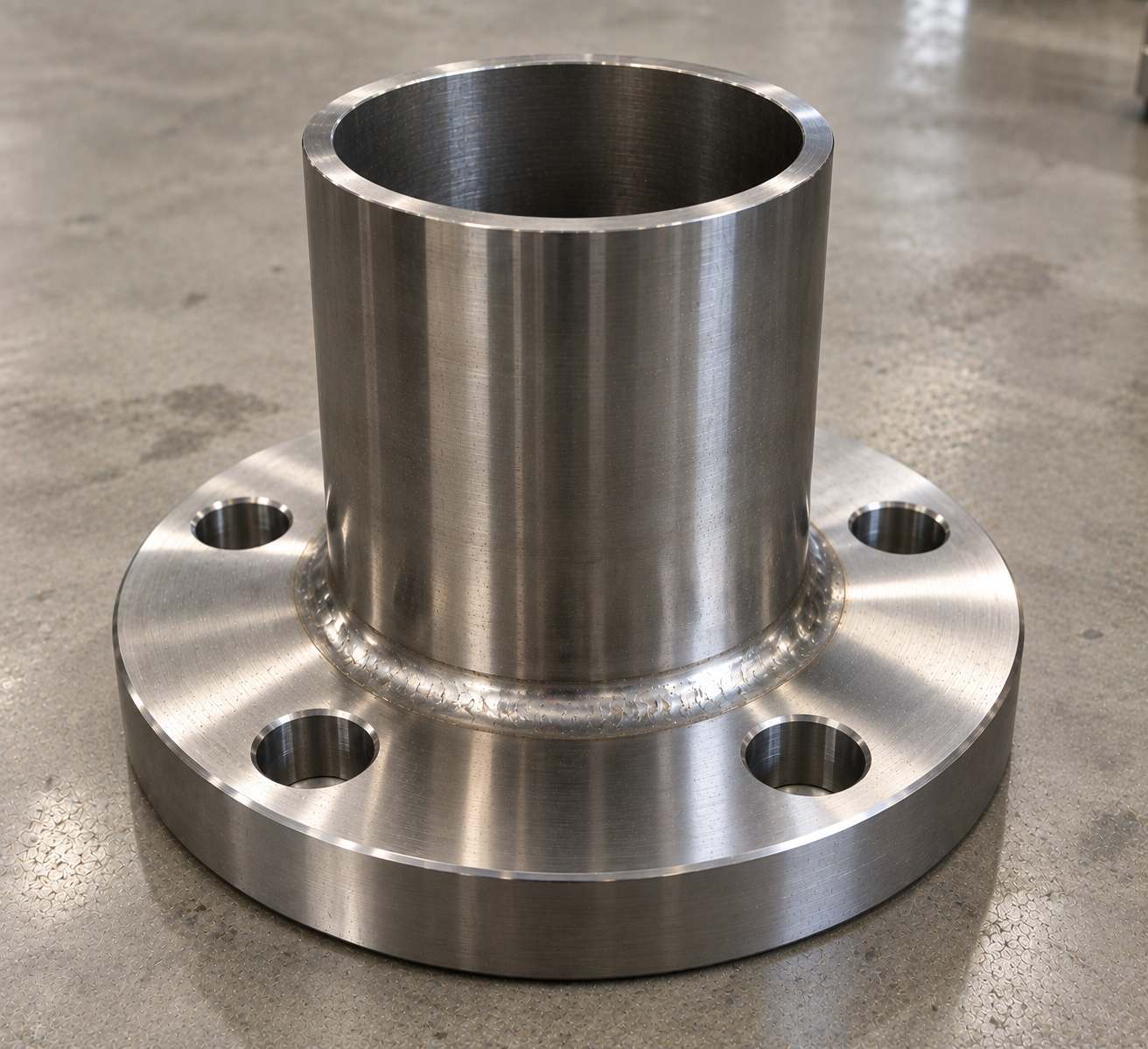
The words in an enquiry should identify both the water stop and any piping connections. Therefore, use the descriptions below consistently.
| Puddle flange | A projecting water-stop plate or collar around a pipe penetration through concrete. |
|---|---|
| Penetration pipe | A complete pipe or sleeve assembly that incorporates the water-stop plate. |
| End flange | A separate bolted connection flange with a standard, rating, facing and drilling. |
| Puddle plate | The embedded plate that projects radially into the concrete around the pipe. |
| Pipe size | Nominal size plus actual outside diameter, wall thickness and dimensional standard. |
| Plate dimensions | Outside diameter or width, radial projection, thickness, pipe opening and position. |
| Assembly length | Overall or face-to-face length with internal and external end projections. |
| Material | Separate standards and grades for pipe, plate, fittings and connection flanges. |
| Concrete detail | Wall or slab thickness, reinforcement clearance, embedment and installation position. |
| Inspection | Material, dimensions, joints, finish and documentation according to the project. |
Naming note: Use “flange puddle” only as a search variation where natural. For technical documents, use the conventional product term and identify any bolted end flange separately.
The reversed phrase may refer to several related products. Consequently, buyers should confirm the intended configuration before requesting a quote.
A separate collar fits or attaches around a compatible pipe before concrete placement.
A workshop fabricates the pipe and central water-stop plate as one drawing-defined assembly.
The assembly combines an embedded plate with one or more bolted connection flanges.
A suitable adjustable design can support positioning or installation around an existing pipe.
Compare the adjustable design, single-ended configuration and two-ended configuration.
The word “flange” can cause confusion because the two components perform different jobs. Therefore, distinguish them clearly:
Specification warning: Do not describe the embedded plate only as Class 150, raised face or RTJ. Instead, assign those details to an actual connection flange when the assembly includes one. For conventional connection terminology, consult the official ASME codes and standards catalogue.
The result depends on correct design, positioning and concrete placement.
First, confirm pipe size, material, wall thickness and the concrete section.
Next, define the puddle plate projection, thickness and position.
Then, fabricate or attach the water-stop component through the approved method.
Installers maintain line, level, orientation and end projection within the formwork.
Afterwards, workers consolidate concrete around both faces of the projecting plate.
Finally, the site team inspects exposed ends and finishes the specified piping joints.
Clear terminology prevents incorrect manufacturing and certification expectations. Accordingly, avoid these common errors.
First, confirm the actual pipe OD and standard instead of providing only a nominal millimetre size.
Do not assign a connection-flange class or facing to the central plate without a valid design basis.
The drawing must define plate projection, thickness and position rather than leaving them to assumption.
Finally, specify separate standards and grades for pipe, plate, fittings and end flanges.
Projects use embedded water-stop collars wherever a pipe crosses a concrete boundary. For example, applications include:
Additionally, review our guidance for water-tank penetrations, drain applications and concrete-wall installations.
To avoid ambiguity from the phrase “flange puddle,” send the following technical information:
In most searches, yes. However, the conventional engineering name provides clearer product wording.
Its projecting plate helps interrupt water movement along the outside of a pipe that passes through concrete.
Not necessarily. A puddle plate can act as an embedded water stop without bolt holes, facing or a pressure class.
Yes. A pipe can include a central puddle plate and one or two separate bolted end flanges.
Use the conventional engineering term or “pipe with water-stop plate.” Then, identify any end flange separately with its complete specification.
Provide the pipe OD and wall, plate OD and thickness, plate position, concrete thickness, assembly length and end details.
First, send the approved penetration drawing. Next, provide all pipe, plate, flange, material, inspection, coating and quantity requirements.
Send Mesta Inc. your pipe dimensions, water-stop plate details, material, drawing, quantity, inspection scope and delivery requirements. Then, our team will review the enquiry and confirm the appropriate manufacturing scope.