
Fixed Puddle Flange
For a fixed type, the plate has a predetermined location on the pipe or sleeve. Consequently, the workshop must follow the approved embedment dimension.
Puddle Flange Types include fixed, adjustable, loose, split, flanged, plastic and special-alloy configurations. Therefore, identify the pipe and installation condition first; then, compare plate geometry, material and end connections.
Puddle Flange Types differ by installation method, pipe material, plate shape and connection configuration. Consequently, the correct category depends on the pipe system, concrete structure, service environment and construction sequence.
A fixed welded plate may suit a new carbon-steel sleeve, while a split or adjustable water stop may suit a pipe with restricted end access. Similarly, plastic pipe systems need material-compatible designs rather than a welded metal collar.
This guide compares the principal options and links to detailed product pages. However, the approved drawing must still define the final pipe OD, plate geometry, material, attachment and end connections.
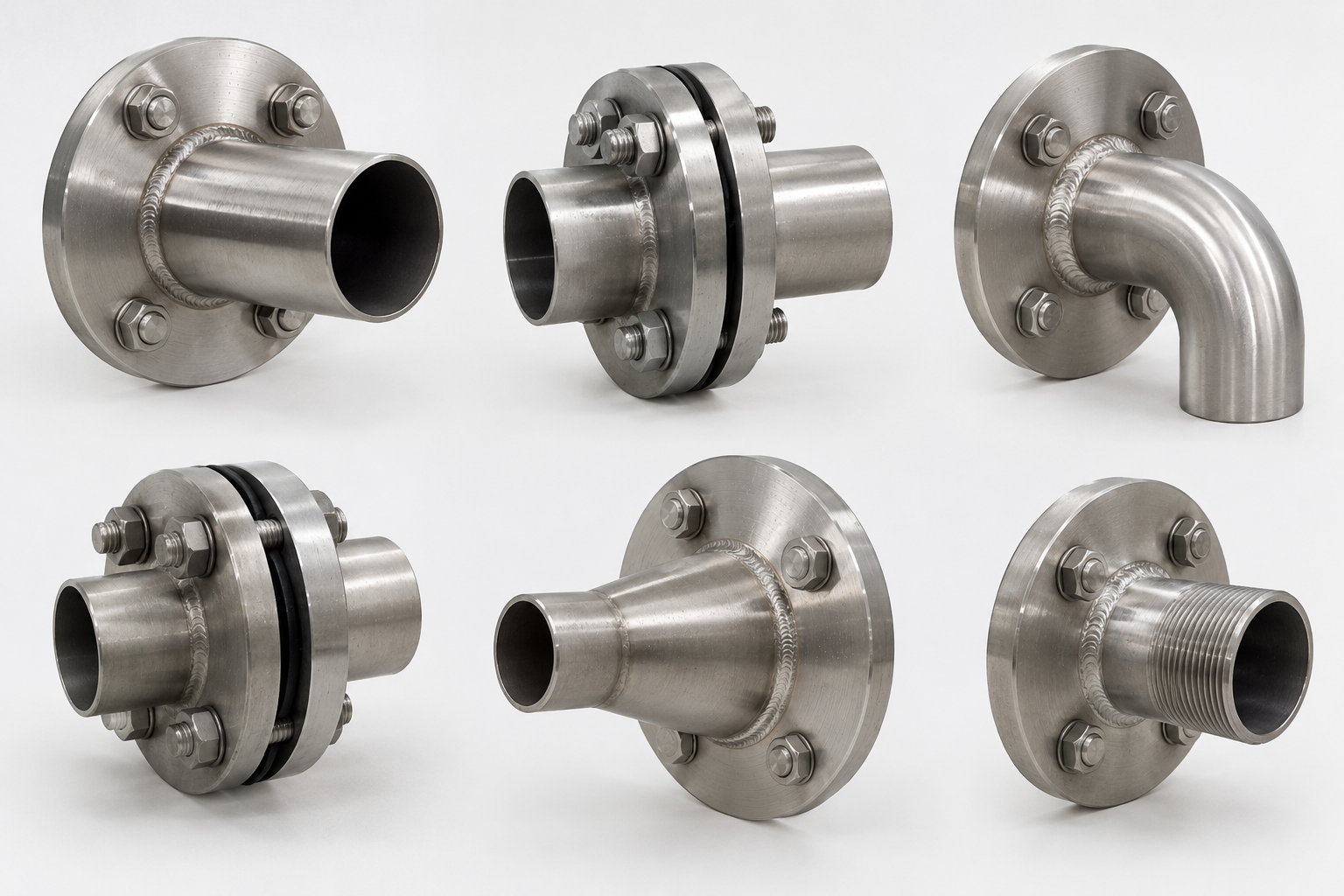
The following comparison explains each broad type and the information needed for selection.
| Puddle flange type | Typical selection basis |
|---|---|
| Fixed puddle flange | Permanent plate position on a new pipe or sleeve with fully defined embedment dimensions. |
| Adjustable puddle flange | Approved design that permits limited positioning or configuration before final securing. |
| Loose or split puddle flange | Pipe with restricted end access or a design that requires assembly around an existing pipe. |
| Pipe puddle flange | Complete pipe or sleeve with a central water-stop plate and project-defined ends. |
| Single-flanged pipe | One bolted end connection plus a plain, bevelled, socket or other opposite end. |
| Double-flanged pipe | Bolted connections on both sides of the penetration with controlled face-to-face dimensions. |
| Flange-spigot pipe | One bolted flange and one spigot or plain end for dissimilar connection methods. |
| Square puddle flange | Drawing-defined square water-stop plate where structural geometry or project preference requires it. |
| Plastic puddle flange | PVC, uPVC, CPVC, PE or HDPE system with a material-compatible attachment method. |
| Special-alloy puddle flange | Duplex, super duplex, nickel alloy or other material for demanding corrosion conditions. |
Classification note: One product can belong to several categories. For example, an assembly may be fixed, double-flanged, square-plated and stainless steel at the same time.
The construction sequence and pipe access determine whether installers need a permanent or position-adjustable design.
For a fixed type, the plate has a predetermined location on the pipe or sleeve. Consequently, the workshop must follow the approved embedment dimension.
By contrast, an adjustable puddle flange offers a defined positioning function before installers secure it.
Alternatively, a loose puddle flange may use a separate collar that installers position during assembly.
For retrofit work, a split design can fit around an existing pipe when the open end remains inaccessible.
A central puddle plate creates the embedded water stop, while the pipe ends connect to the surrounding system. Therefore, specify these functions separately.
For example, plain projections support the approved site jointing method and require sufficient accessible length.
Similarly, a single-flanged pipe provides one bolted end and a different opposite connection.
Meanwhile, a double-flanged pipe provides bolted connections on both sides of the structure.
Alternatively, a flange-spigot assembly combines a bolted flange with a spigot or plain connection.
When an assembly includes conventional bolted pipe flanges, the project may specify a relevant standard such as ASME B16.5. Nevertheless, that connection-flange standard does not define the central puddle plate.
Material selection depends on the pipe, conveyed medium, external exposure, joining method and required service life.
Mild and carbon steel offer flexible fabrication. However, the project should specify suitable corrosion protection.
Stainless steel puddle flanges suit applications that require improved corrosion resistance or hygiene.
PE puddle flanges need compatible fabrication and SDR-specific pipe data.
Plastic water stops require the correct pipe standard, actual OD and approved joining method.
These stainless grades may suit specified chloride or aggressive environments after engineering review.
Nickel-alloy assemblies address specialized chemical or corrosion conditions when the project specifies them.
Plate shape influences fabrication, reinforcement clearance and orientation. Accordingly, the approved drawing should define the complete geometry.
First, a circular plate provides consistent radial projection and requires no corner orientation.
By contrast, a square plate uses defined width, height and corner geometry. Moreover, inspectors must verify its rotation.
For special constraints, a custom profile may help; however, the engineer must approve its dimensions.
Finally, some designs may use more than one plate. In that case, the drawing must define spacing and fabrication details.
Application pages should explain the service condition rather than duplicate generic product descriptions. For example, puddle flanges support:
Start with the pipe and concrete detail instead of selecting only by product name. Then, provide:
Generally, the main categories include fixed, adjustable, loose, split, pipe-mounted, single-flanged, double-flanged, square, plastic and special-alloy puddle flanges.
A fixed plate has a predetermined position. By contrast, an adjustable type provides a defined positioning function before final securing.
For example, a split design may suit an existing pipe where installers cannot slide a one-piece component over the pipe end.
The puddle plate remains embedded in concrete and acts as a water stop. An end flange creates a bolted pipe connection outside the concrete.
Use the geometry that the approved structural and waterproofing drawing specifies. Neither shape is universally correct for every penetration.
Ultimately, the best material depends on the pipe, water or chemical exposure, joining method, corrosion risk and project requirements.
Send the pipe data, concrete thickness, plate geometry, installation type, end connections, material, finish, quantity and drawing.
Send Mesta Inc. your pipe dimensions, puddle plate details, material, drawing, quantity, inspection scope and delivery requirements. Then, our team will review the enquiry and confirm the appropriate manufacturing scope.